

A tax-free savings account over-contribution occurs when you put more money than the maximum amount allowed by law. As a newcomer who recently moved to Canada, you should know how to avoid tax penalties on your tax-free savings account. You should know that putting extra money into a TFSA activates a 1% tax penalty from the CRA on the excess amount.
There are core rules that you should know as a newcomer in Canada, which include your start-of-year arrival, early contribution room when you are 18 years old and considered a resident of Canada for tax purposes. It is advised to avoid using cash or debit. You must use a Canadian credit card responsibly to build a credit score, which you need to rent an apartment or get a phone plan. You should act as your own bookkeeper by recording all cash movements in one file, rather than waiting for bank apps to track your total financial picture.

New to Canada? Here is a guide to understanding how TFSA over-contributions happen.
Replacing a withdrawal before you are not allowed to
- If you pull money out and put it right back into your TFSA during the same
- Instead, it counts as a brand-new contribution, using up whatever current-year contribution room you have left.
Putting money into 2 different accounts
- If you take out money from bank A and walk across the city to deposit into bank B, it does not reset your room right away.
- If you deposit it during that same year, it counts as fresh funds that will be added for the current tax year.
Failing to calculate your starting date
- Your lifetime TFSA contribution room begins when you turn 18 or when you have a Social Insurance Number.
- If you forget the date you became a resident of Canada or the year, your cumulative calculation of unused room will be too high, leading to an accidental over-contribution the moment you deposit funds based on that wrong total.
Managing contributions for a deceased account holder
- Contributing on behalf of the deceased account without understanding how
- TFSA contribution room is managed after death means making mistakes in depositing, withdrawing, and contributing money into or out of the account.
- If the amount transferred exceeds the allowed fair market value limits or rules, or if it isn’t properly designated, it will be regarded as a TFSA Over-Contribution.
Facts that newcomers should know about TFSA
The dates should be known to avoid miscalculations
- It is important to know the dates because they are helpful when calculating total cumulative tax-free savings account limits and avoiding accidental over-contributions.
- Miscalculation of your room accumulation and putting in more than the maximum amount required; the CRA guidelines apply a strict penalty of 1% per month.
You have to compile and update all your financial records.
- You need to keep your own personal log of every deposit and withdrawal across all your Tax-Free Savings Account (TFSA) providers.
- By keeping a simple spreadsheet or ledger of every dollar you deposit or pull out across every single account, you always know your true, up-to-date contribution total relative to your maximum allowed limit.
To make sure your records are in order, you can use your My CRA account to verify the transactions.
- Checking your records summary through your My CRA account can help you verify your current and recent contributions, withdrawals, and remaining contributing room.
- Reviewing your summary lets you spot missing or duplicate entries early and contact your financial institution to fix them before they affect your tax status.
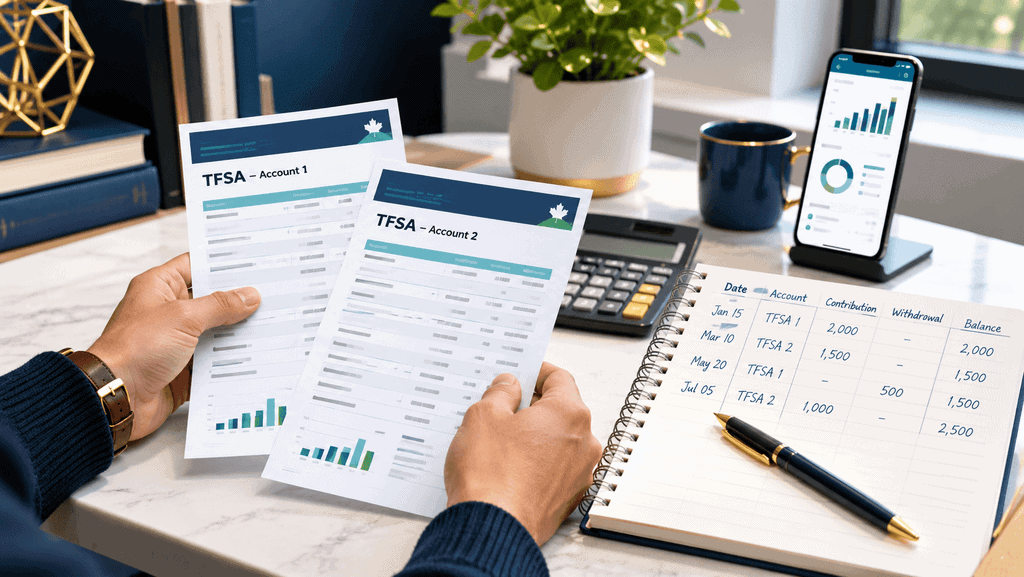
Summary of TFSA over-contribution for newcomers in Canada
If you understand TFSA over-contributions, just know you are on the safe side because it helps you know how contribution room access amounts and calendar year timing. The Canada Revenue Agency is responsible for tracking contributions across all TFSA accounts and calculates penalties at one percent per month using the highest amount. Situations that you should keep in mind that trigger penalties are depositing money too early, contributing across multiple providers, and contributing while you’re still a non-resident.
An overcontribution (you’ll find this by checking your CRA records) must be withdrawn from the financial institutions where you have it. Keeping your financial receipts and government letters can help you improve tax numbers and prevent accidental overcontributions. Also, you are supposed to monitor your past deposits and withdrawals using CRA My Account, which helps you know how much money you are supposed to put inside the TFSA without breaking the law.
For a wider savings strategy, newcomers may also compare registered retirement savings plans (RRSPs), non-registered investments and financial planning for retirement. A compound interest calculator can help model hypothetical savings growth, although it cannot verify TFSA contribution room; check CRA records and your own transaction history for that purpose.
Insure Horizons- We make sure to help our clients choose the right insurance policy to protect their daily lives from unexpected shocks and crises that may arise. Choosing a policy with the help of expert Jas Hans allows people to get great services that ensure they live their lives stress-free.
We are always available to help you; feel free to contact us at 587-572-7000, email us at jas-hans@gmail.com, or visit us at 275 Lake Pointe Dr, Chestermere, AB T1X 0R2. We can address your questions and issues and provide guidance that will help you select the right insurance that covers your needs.
FAQs
1. When do newcomers start earning TFSA contribution room?
Usually, you get the earning room when you are 18 years or older, have a valid SIN number and become a Canadian resident for tax purposes. Even if you arrive late in the year, you still get the entire annual TFSA limit for that year.
2. What should I do when I find out that I overcontributed?
You have to withdraw the moment you realize that you overcontributed to avoid a 1 percent monthly penalty from increasing. Also, you can write a short letter to the CRA explaining that it was an honest mistake and show proof that you took the money out right away.
3. What will happen to my account when I’m leaving Canada?
Nothing will happen to it, and you can take it to your home country, and the savings will increase in Canada. However, once you are out there, you’ll have to find the urge to save money.
4. What do I need to know before I open a Tax-Free Savings Account so that I don’t get blindsided?
Dates must be calculated to work out total cumulative tax-free savings account limits to avoid accidentally overcontributing.
5. What if I’m not obeying the TFSA rules?
If you break TFSA rules, the Canada Revenue Agency (CRA) will penalize you, and your investment gains will no longer be tax-free. The penalty you face depends on which of their rules you violated.